 EN
EN


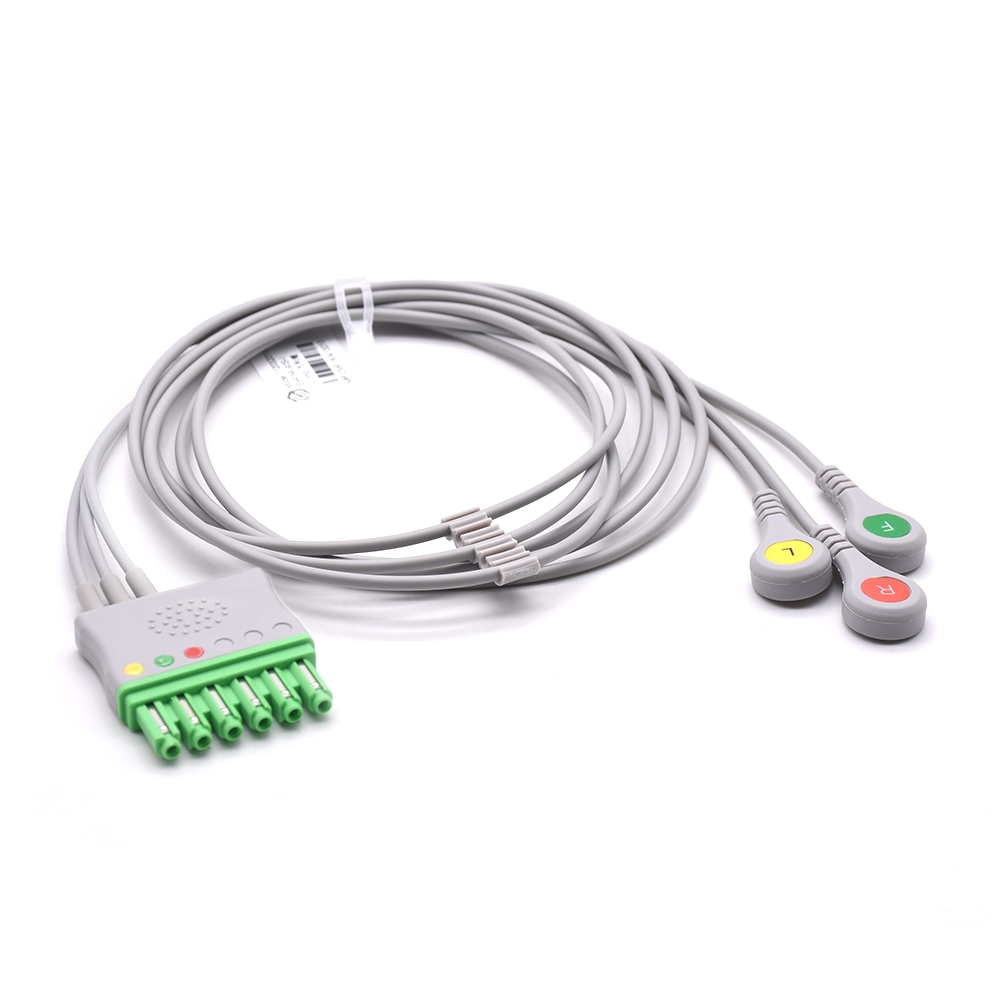
Understanding Electromagnetic Interference (EMI) in ECG Cables
Electromagnetic interference (EMI) disrupts the microvolt-level signals transmitted through ECG cables during cardiac monitoring. This interference arises from environmental radiation and conductive coupling, introducing artifacts that mimic or obscure true heart rhythms.
What Is Electromagnetic Interference and How It Distorts ECG Signals?
EMI occurs when external electromagnetic fields induce unwanted currents in ECG cable conductors. These parasitic signals overlay genuine cardiac activity, appearing as baseline drift, high-frequency noise, or 60 Hz sinusoidal patterns that can mask critical features like P-waves and ST-segments–key elements in diagnosing arrhythmias and ischemia.
Common Sources of EMI in Clinical Environments
Hospitals host numerous EMI sources, including MRI machines (3–7 Tesla), wireless infusion pumps operating at 2.4 GHz, and electrosurgical units emitting broadband RF noise. Even aging fluorescent lights with unshielded ballasts generate 100–400 Hz harmonics, contributing to signal contamination in sensitive monitoring environments.
The Impact of 60 Hz Power Line Interference on ECG Readings
The 60 Hz alternating current in building wiring produces a dominant interference frequency within the ECG signal bandwidth (0.05–150 Hz). This creates a characteristic "hum" that can elevate noise levels to 500 μV–five times the amplitude of typical QRS complexes–potentially obscuring subtle ST-segment changes indicative of myocardial ischemia.
How ECG Artifacts Compromise Diagnostic Accuracy
A 2023 ICU study found that unfiltered EMI artifacts increased false arrhythmia alarms by 42% compared to shielded systems. Such errors delay clinical decisions and increase workload, with hospital audits showing 30% longer ECG interpretation times in high-EMI areas like catheterization labs.
Shielding and Insulation: The First Line of Defense in ECG Cables
Braided Shielding and Its Role in Blocking External EMI
ECG cables use braided copper shielding, often combined with aluminum foil, to create a Faraday cage effect against EMI. This dual-layer design achieves 85–90 dB attenuation, blocking up to 98% of external interference in challenging environments such as MRI suites, preserving signal integrity during critical procedures.
Dielectric Insulation Materials in High-Quality ECG Patient Cables
High-purity polyethylene and PVC serve as dielectric insulators, preventing signal leakage and maintaining stable capacitance (<52 pF/m). Their non-conductive properties isolate internal conductors from external contact, ensuring consistent performance even after repeated sterilization cycles.
Shielded vs. Unshielded ECG Cables in Noisy Medical Settings
| Metric | Shielded ECG Cables | Unshielded ECG Cables |
|---|---|---|
| Noise suppression | 85–90 dB attenuation | 15–20 dB attenuation |
| Critical care usability | Suitable for MRI/ICU | Restricted to low-noise areas |
| Motion artifact rate | 2.1 events/hour | 9.8 events/hour |
A 2023 Cardiovascular Engineering study showed shielded cables achieved 92% diagnostic accuracy during emergency transport, compared to 67% for unshielded models. Hospitals using shielded systems report 43% fewer repeat stress tests due to improved signal clarity.
Advanced Design Features That Enhance Signal Fidelity in ECG Cables
Twisted Pair Conductors for Induced Noise Cancellation
Twisted pair conductors mitigate EMI by equalizing electromagnetic exposure across both wires, enabling noise cancellation through balanced signal transmission. Research indicates this configuration reduces crosstalk by 60% versus flat conductor layouts, enhancing visualization of P-waves and ST-segments essential for accurate arrhythmia detection.
Differential Amplifiers and Common-Mode Noise Rejection
Modern ECG systems combine shielded cables with differential amplifiers that reject common-mode noise–interference present equally on both inputs. By measuring only the voltage difference between electrodes, these amplifiers reduce baseline wander by 85% in electromagnetically noisy settings such as those near MRI units or electrosurgical devices.
Connector Integrity and Contact Stability to Prevent Artifacts
| Connector Feature | Impact on Signal Quality | Clinical Benefit |
|---|---|---|
| Gold-plated pins | Reduces impedance variance by 73% (ICU trials, 2020) | Prevents T-wave inversion artifacts |
| Spring-loaded contacts | Maintains connectivity during patient movement | Eliminates signal dropouts in stress tests |
| Silicone strain relief | Withstands 10,000+ flex cycles | Ensures longevity in telemetry units |
Miniaturization and Flexibility Without Sacrificing ECG Signal Quality
Advances in flexible hybrid electronics enable thinner ECG cables (as small as 1.2 mm diameter) to bend around joints without compromising shielding. These designs reduce motion artifacts by 40% in home monitoring while supporting diagnostic-grade sampling at 1 kHz, making them ideal for telemedicine applications.
Filtering Technologies to Eliminate Noise in ECG Signal Processing
Hardware Notch Filters for Targeted 60 Hz Interference Removal
Hardware notch filters selectively attenuate 60 Hz power line interference, which can distort cardiac signals by up to 40% in unshielded setups. These analog circuits preserve critical components like QRS complexes while reducing baseline noise. A 2024 study demonstrated that combining notch filters with shielding reduced noise by 67% compared to shielding alone.
Digital Signal Processing in Modern ECG Machines
Digital signal processing employs wavelet transforms and machine learning algorithms to identify and remove artifacts while preserving waveform morphology. Median filters improve signal-to-noise ratio (SNR) by 30.96 dB–three times more effectively than moving average methods–and real-time correction compensates for motion-related noise in ambulatory monitoring.
Adaptive Filtering for Dynamic and Variable Interference Environments
Adaptive filters dynamically adjust to changing electromagnetic conditions, crucial in mobile and wearable settings. The UNANR system achieved 94% artifact suppression in ICU trials by continuously recalibrating to ambient interference. This capability is especially valuable for wearable ECG devices exposed to Bluetooth, Wi-Fi, and other wireless signals.
Clinical Validation and Real-World Performance of Anti-Interference ECG Cables
ICU Study: Standard vs. High-Shield ECG Cables in Critical Care
A 2023 study in Cardiovascular Engineering found high-shield cables improved diagnostic accuracy to 92% during emergency transport versus 67% with standard cables. Triple-layer aluminum-mylar shielding blocked 92% of EMI from MRI machines and defibrillators, reducing false ST-segment interpretations by 41%. Hospitals adopting these systems report 43% fewer repeat stress tests due to enhanced signal fidelity.
Portable ECG Monitoring in Ambulances: Overcoming Mobile Interference
Ambulance ECG systems counteract mobile interference using:
- Conductive hydrogel electrodes that maintain <5 µV noise during motion
- Bluetooth 5.2 with 128-bit AES encryption for secure, low-noise transmission
These innovations allow EMTs to achieve hospital-grade monitoring despite interference from ignition systems and 5G devices. Field tests show shielded cables reduce motion artifacts by 65% during transport compared to conventional designs.
Telemedicine Applications and the Need for Reliable ECG Transmission
According to the American College of Cardiology report from 2023, around 73% of hospitals now rely on centralized cardiac monitoring systems, so getting those signals transmitted properly really matters. Using oxygen free copper wires helps cut down on signal loss during transmission. Meanwhile, adaptive filters do a good job at blocking out common sources of interference like the standard 50 or 60 Hz hum, background noise from nearby Wi-Fi networks operating at 2.4 GHz, and even muscle movements that create artifacts between 5 to 150 Hz frequencies. Some recent tests in telemedicine back this up too. A trial conducted in 2024 showed that when patients used these improved monitoring setups at home instead of traditional cables, doctors made about 58% fewer mistakes in their diagnoses.
FAQs
What is EMI and how does it affect ECG signals?
EMI, or electromagnetic interference, occurs when external electromagnetic fields induce unwanted currents in ECG cables, leading to artifacts that may obscure true cardiac rhythms.
Why is shielding important in ECG cables?
Shielding protects ECG cables from external EMI by creating a Faraday cage effect that blocks interference, ensuring the integrity of cardiac signals.
How do adaptive filters help in ECG signal processing?
Adaptive filters continuously adjust to dynamic interference conditions, suppressing artifacts and enhancing signal clarity in mobile and wearable ECG settings.
Are shielded ECG cables suitable for all clinical environments?
Shielded ECG cables are particularly effective in high-EMI environments, like MRI suites, but can be utilized in various clinical settings for enhanced noise suppression.
Table of Contents
- Understanding Electromagnetic Interference (EMI) in ECG Cables
- Shielding and Insulation: The First Line of Defense in ECG Cables
- Advanced Design Features That Enhance Signal Fidelity in ECG Cables
- Filtering Technologies to Eliminate Noise in ECG Signal Processing
- Clinical Validation and Real-World Performance of Anti-Interference ECG Cables
- FAQs